
Starts visit one
Pain
Quiet the muscles down.
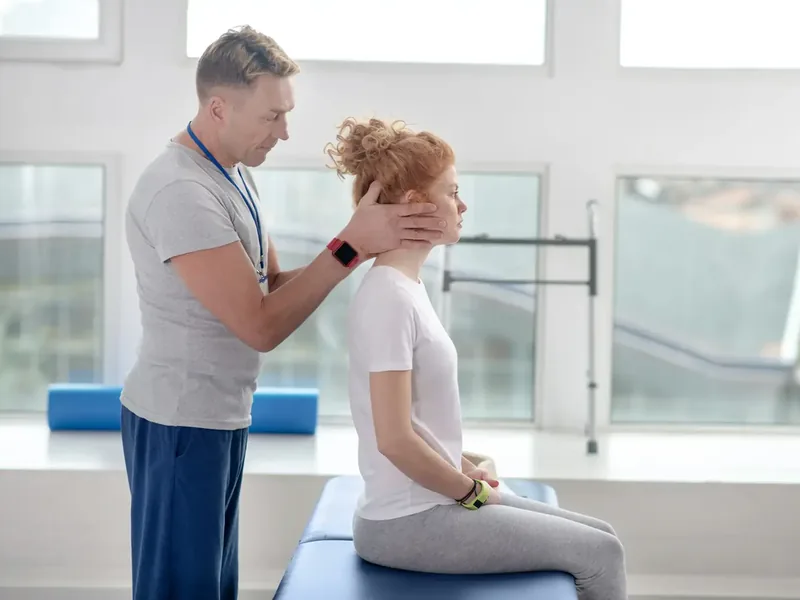
Hands-on work to the chewing muscles and upper neck takes pressure off the joint, starting your very first visit.
What We Treat
Most people don’t know a physical therapist treats jaws. Your jaw is a joint, with muscles and a disc, and it answers to hands-on care like any other. A cause-first evaluation checks your neck too, because the two rarely act alone.
Sound Familiar?
Two or more? That’s a joint problem, and joints are what we do. Keep reading.
Why It Happens
The jaw joint has muscles, ligaments and a small disc, and it moves more often than almost any joint you own. Pain there is usually a mix. Chewing muscles overworked by clenching. A disc that stopped tracking smoothly, which is the click. Stiffness in the upper neck, which changes how the jaw rests and loads. Plus habits: gum, side sleeping, phone posture, stress you hold in your face.
You’re the one who absorbs the stress so nobody else has to. Your jaw has been keeping score. That isn’t a character flaw, it’s a load problem, and load problems respond to treatment. A cause-first evaluation sorts out which of those pieces is driving your symptoms. We work with your dentist rather than around them, and we don’t replace dental care.
The Honest Truth
Nobody regrets starting too early. Plenty of people wish somebody had told them a physical therapist could help.
How We Fix It
Every plan has an endpoint. Care directed by a licensed physical therapist, every visit. Here’s what the four phases look like for TMJ and TMD.
Starts visit one
Pain
Hands-on work to the chewing muscles and upper neck takes pressure off the joint, starting your very first visit.
Once the jaw settles
Prime
Gentle joint and soft tissue work restores smooth opening, so the jaw stops catching on the way down.
Once it opens freely
Perform
Control work for opening, chewing and resting position, so the joint shares load instead of grinding through it.
Before we sign off
Prevent
You leave with habit changes that actually stick and a plan for stressful weeks: that’s the endpoint, not a standing appointment.
They inform me about the exercises before I get started. They give the best care for me and my physical ailments.
Shared by Janis W. · TMJ & TMD
Exercises to do, and no explanation of what they were for
Informed about every exercise before she starts it
Questions, Answered
See your dentist for teeth, bite and appliances. That work is theirs, not ours, and we do not replace it. For the joint and the muscles that move it, imaging is rarely the first step, because a film does not show an overloaded chewing muscle or a stiff upper neck. A hands-on evaluation does. If you already wear a night guard or a splint, bring that detail with you and we work alongside it.
Yes, when the movement is dosed properly. A click is common, and on its own it is not damage. What we avoid is forcing range through a painful catch. Instead we work below the point that provokes it and build control there first. A licensed physical therapist sets that range at your evaluation, then moves it as the jaw settles.
You get an estimated number of visits at your evaluation, and a reason for the number. Your plan runs through all four phases, Pain, Prime, Perform, and Prevent, and you will always know which one you are in and what is left. Jaw work usually includes the neck, so one plan covers both rather than sending you to two places.
Still Deciding?
You don’t need to know which clinic or which service is right before you reach out. Start a request, or call the clinic closest to you, and we’ll help you sort out the rest.
5.0 · 866 Google reviews
Let’s start with your name.
Start your request on our secure patient portal. It’s the same place every appointment request on this site goes, so nothing gets lost along the way.
Start My Request (opens in new tab)Opens our patient portal at patients.moorephysicaltherapy.com.
Visit Us